
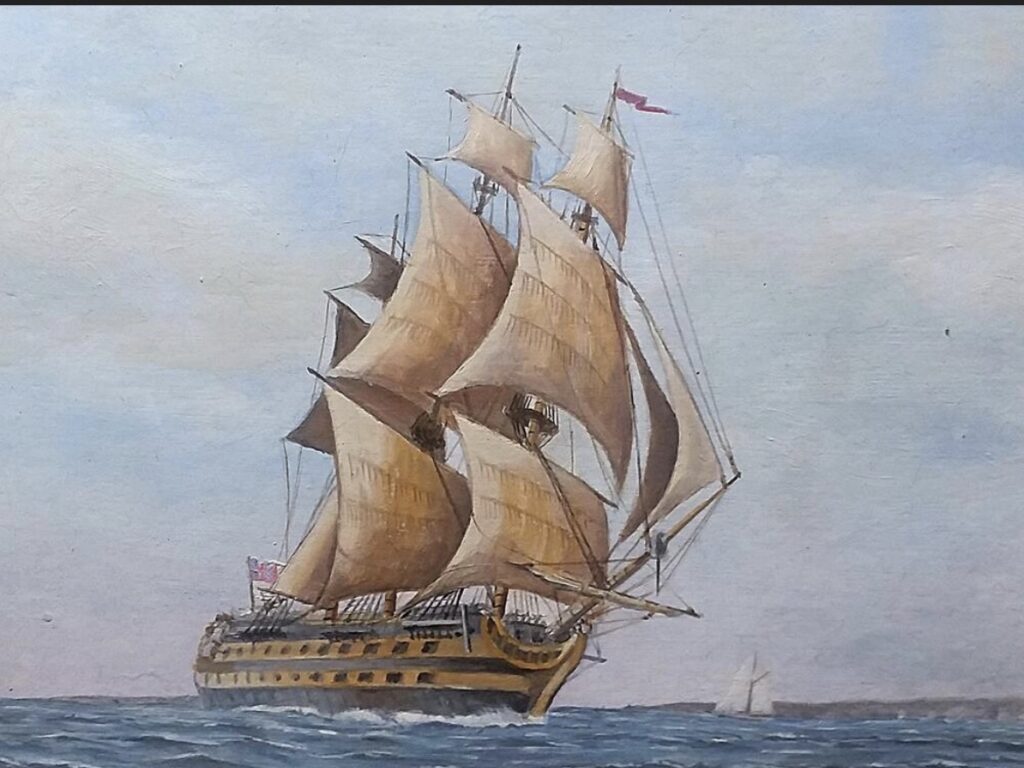
Sustained energy, persistence; never tired or discouraged.
When I was a prolific reader of British naval history both fiction and non-fiction, the name of the British Royal Navy ship HMS Indefatigable caught my attention. I thought and still believe that old sailing warships were given great majestic and really cool names, sometimes mythological, in the days before they started to become more affected by institutions and political causes (probably thanks to the American Republic and the post revolution French “Viva Egalite”).
Despite the transition in how ships are named, most sailors will still have a rare affection for the ships they serve on.
HMS Indefatigable was built and commissioned as a 74-gun Ship of the Line, also known as. 3rd Rate ship which carried between 60-80 cannons. The Rate system, had six categories from First Rate, with the most numbers guns (over 100) to Sixth Rate, which were the most lightly arms but typically fast and nimble, often used as couriers. The 74-gun ships of the line were the workhorse of the British fleet’s line of battle, the backbone of the fighting order which had developed among the major nations during the Age of Sail.
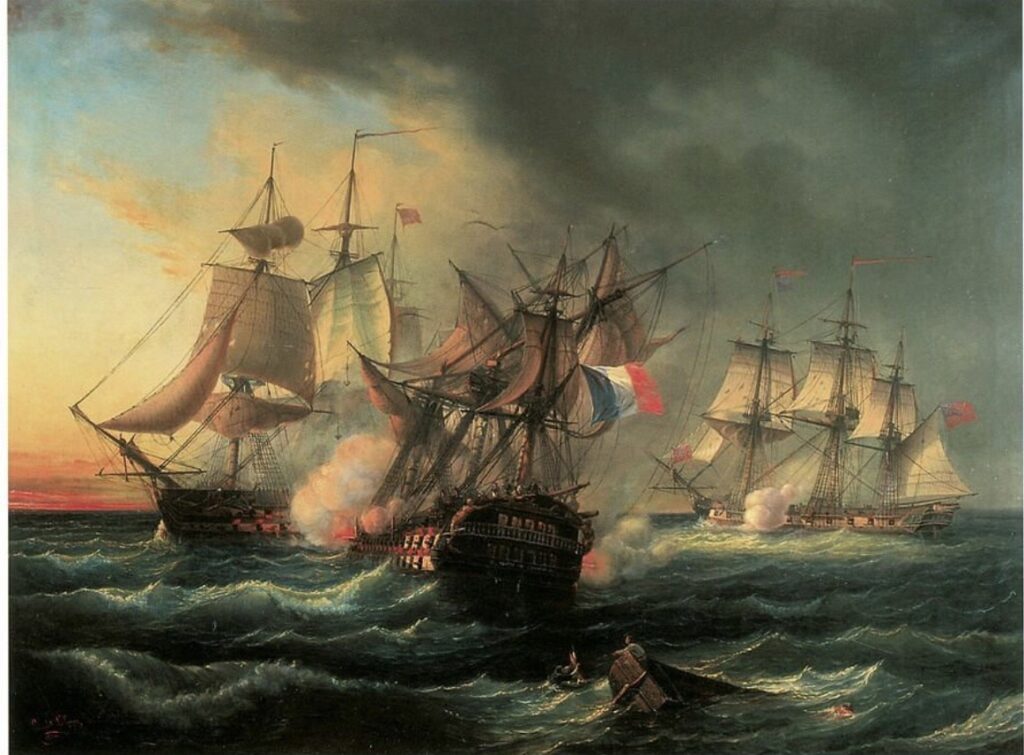
The principle of the line of battle lay in the formation of a tightly held line to create wall of cannon in which to fight with the largest ships with the most guns leading the line engaging the enemy fleet broadsides to broadside. A tight line, was like an impenetrable chain that kept the enemy from both “raking” (being attacked from the very vulnerable bow or stern) and engaging the line from two sides.
It was important to hold the line tightly to create a devastating wall of fire from multiple ships. This generally was custom based on the reality that most crews could not fight effectively without mutual support of the adjacent ships in the line and the 74 gun ships, which had voluminous fire power, but were not so fine to sail as were, for instance, the frigates which in the British Navy rated between 20 to 40 guns which would turn into matchsticks trading broadsides with a 3rd rate ship or above with their 60 to 100+ gun batteries with heavier cannon. In other words, the line of battleship was primarily use to position a wall of cannon fire against the enemies wall of fire in a brutal slugfest in open ocean. Frigates tended to stay out of the line and act as auxiliaries behind the line of battle.
Because the British Navy tended to do most of the blockading of their enemies, the sailing skill of British crews were superior to their French and Spanish counterparts. The Americans very experienced sailors (being a spin off England) though the American navy was just getting established in the late 18th Century.
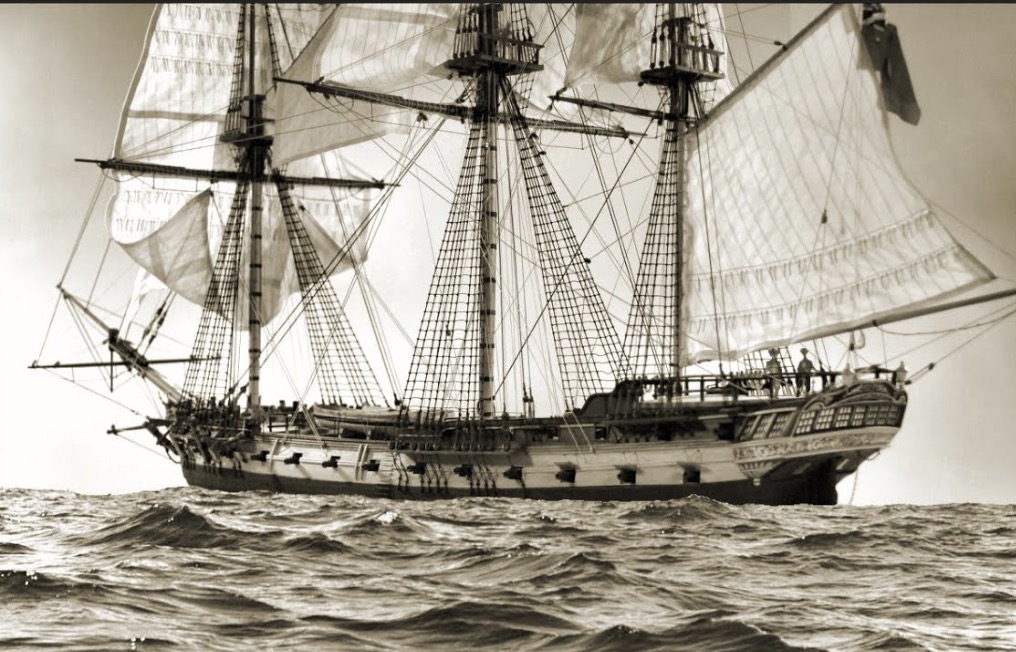
s were refitted by “razoring off” the upper gun deck to create a new class of ship that had framing strong enough to handle 24 or 36 pound cannons with the increased speed and more weatherly handling of a lighter ship. These were designed to help match the American ships, like the USS Constitution (44), which were very fast, strong (i.e. “Old Ironsides”) and had a heavier broadside than all British Frigates.
The Lore of the Age of Sail: Prize Captains
Naval history is full of sailors who necessarily venerated the complex ships they manned and kept afloat. The ship also served to keep them alive and to transport them into the glorious tests of battle and also the possibility of prize money. Back during that era, both navies and privateers (sort of like Naval contractors) were rewarded through the capture of enemy ships and the wealth contained in those ships were, in part, distributed to the victorious ship’s captain (who garnered a significant percentage), and to the officers and crew much lesser percentages.
Hence it was often the case that experienced sailors very much appreciated the opportunity to serve under a captain known for both his battle prowess and his ability to seize prize vessels which could be more lucrative than simply surviving on the pay that the navy offered.
Long ocean voyages were common and through the accumulated lore, legends, traditions and rituals of life at sea was developed a natural idolization of ships and captains.
Captains of the era were men who served as absolute authority given to them from he Crown (under the regulations of the navy) and carried a God-like role on board these vessels which, if operating in a detached nature bore absolute authority over he vessel and the crew.
Master and Commander
I learned recently from an inkl.com article that the 2003 movie, Master and Commander starring Russel Crowe and Paul Bettany has had a resurgence of popularity, especially among younger men. It’s no surprise since the era this movie in particular is ripe with a variety of very manly role models in the height of an existential war between England and Napoleonic France, the two great world adversaries at the time. However, the film not only exudes masculinity from the two main characters, it exudes virtue, strength, courage, patriotism, and bold masculinity from characters of all ages and all manner of crew members, highlighting characteristics desperately missing from society searching for strong “real life” role models over the last couple of decades.
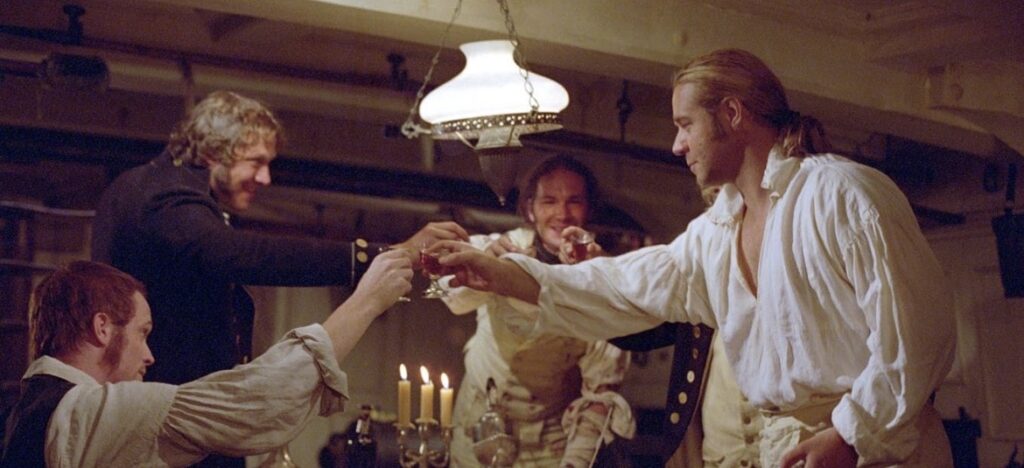
Back in the 1990s, read Patrick O’Brian’s stunningly written novels and reviewers have described O’Brian as the “Jane Austen for Men”. What is quite astonishing is the fact that O’Brian did his writing as an older man in the late 20th Century (his first book was Master and Commander in 1969) whereas Jane Austen was a period writer who lived in the early 19th Century England. O’Brian’s wrote exceedingly well because of his extraordinary research and attention to crafting of relationships, and also love for the sea stories that originates from the Age of Sail.
What elevates O’Brian’s novels to the highest levels is his development of the legendary friendship between two characters, “Lucky” Jack Aubrey and a doctor and research scientist Stephen Maturin. Their unlikely friendship begins at small music concert, if I recall, at a small Spanish city during a period of peace when they immediately find each other annoying and forgetable.
This friendship is given its due in the 2003 movie and this, I believe, is something young men gravitate to, especially on the large screen (for those who are disinclined to read novels): authentic and deep conviction filled relationships that can weather strong argument and passionate manly and painful conflict of interests, and at the same time be held together with a bond of genuine friendship that is profound, all in the context of history tied to these virtually floating sovereign entities that are navy ships at war, embattled by the full degree of naval warfare that is vividly captured by Patrick O’Brian’s pen. O’Brian’s writing engages the reader on multiple levels and far surpasses any other series of historical fiction from the Age of Sail including C.S. Forester’s venerable Hornblower series.
The Sailor turned Father
It’s easy to venerate the God-like figure of the Captain of a ship, particularly by young men who are asked to put their lives on the line and be expected to follow their leader’s orders with utmost confidence through the chain of command. The opposite is also true in that if the leadership qualities of a captain are wanting, that has a strong effect on the moral of the crew. Horatio Nelson (whose monument stands tall in Trafalgar Square in London) is the quintessential, world renowned naval officer who embodied both love of country, innovative strategy, and superb leadership skill, empowering his talented subordinates captains to act with personal initiative, as opposed to dogmatic, ritual obedience to command.
A ship of war is very much like a microcosm of a nation if not the world. As Russell Crowe’s Jack Aubrey motivates his crew before battle, “This (their ship) is England.”
When the man at war is no longer at war, when he is enduring life as a civilian, the need to extol a leader and to seek the principles held by a strong leader from whom confidence and morale is derived from is more important than one would believe. We may be short-sighted in seeing the need for hierarchy and command leadership as something that is only required on a man-of-war because of the existential need in a combat situation. I will expand this thought later in this post.
The Book of Prayer
Sailors in general, who are not in their natural element are surrounded and at the mercy of God upon the sometimes violent and unpredictable seas. This brings all onboard a greater sense of the providence of God and an ever readiness to keep the open line to the divine. Here are a few examples or prayers to Christ.:
A prayer before the storm:
O MOST powerful and glorious Lord God, at whose command the winds blow, and lift up the waves of the sea, and who stillest the rage thereof; We, thy creatures, but miserable sinners, do in this our great distress cry unto thee for help; Save, Lord, or else we perish. We confess, when we have been safe, and seen all things quiet about us, we have forgotten thee our God, and refused to hearken to the still voice of thy word, and to obey thy commandments: But now we see how terrible thou art in all thy works of wonder; the great God to be feared above all: And therefore we adore thy Divine Majesty, acknowledging thy power, and imploring thy goodness. Help, Lord, and save us for thy mercy’s sake, in Jesus Christ, thy Son our Lord. Amen. – from the 1789 Anglican Book of Prayer used aboard Navy ships.
A prayer before battle:
O MOST powerful and glorious Lord God, the Lord of hosts, that rulest and commandest all things; Thou sittest in the throne judging right, and therefore we make our address to thy Divine Majesty in this our necessity, that thou wouldest take the cause into thine own hand, and judge between us and our enemies. Stir up thy strength, O Lord, and come and help us; for thou givest not alway the battle to the strong, but canst save by many or by few. O let not our sins now cry against us for vengeance; but hear us thy poor servants begging mercy, and imploring thy help, and that thou wouldest be a defence unto us against the face of the enemy. Make it appear that thou art our Saviour and mighty Deliverer, through Jesus Christ our Lord. Amen. – from the 1789 Anglican Book of Prayer used aboard Navy ships.
Prayer for burial at sea
WE therefore commit his body to the deep, to be turned into corruption, looking for the resurrection of the body (when the sea shall give up her dead,) and the life of the world to come, through our Lord Jesus Christ; who at his coming shall change our vile body, that it may be like his glorious body, according to the mighty working whereby he is able to subdue all things unto himself. – from the 1789 Anglican Book of Prayer used aboard Navy ships.
The Biblical stories that take place on the waters would be well known to all sailors, from the runaway prophet Jonah, to the Apostle Paul’s shipwreck in a Roman transport off the coast of Malta, and most significantly, the Lord Jesus who rebukes the ocean and storms while His disciples are fearing imminent ruin in the middle of the Sea of Galilee.
In the fight for the long haul
The model of leadership offered by a ship of war offers more associations with the responsibility of a father and his family than most people may think. For instance, the British Royal Navy ship’s commander is a Commission ordered by the King. It’s not a far notion that a father is spirtually commmission by God to lead his family. Both, coincidentally, call upon Almighty God’s blessings in the execution of their duties.
Naval blockades, which were common in the days of sail, are again, front and center in the news around the shores of Iran as of this writing. In blockades, the endurance of naval crews to maintain their station and vigilance are paramount the success. The day in and day out execution of their duties at times may feel monotonous and self-defeating but nothing is further from the truth.
In regard to the battles faced by the family, a father and mother are expected to run their families with a certain indefatigability with a reminder that their often monotonous and seemingly unappreciated efforts are part of God’s plan. It makes all more important to seek God’s grace through His purposes for our earthly lives, why our ultimate peace and satisfaction comes from a place that is far beyond our circumstances.
There are many ways God may bless a person, and one is that of zeal. Zeal may come in the form of being indefatigable which is described as one having sustained energy, persistence; never tired or discouraged. These traits would be quite valuable for parents, and praying for these gifts would be within the purview of servants of God.
As Christians, we spend less time focusing on our personal attributes than we do on the attributes of God Himself, of the Lord Jesus Christ, the Savior, Himself, it’s one of the keys to becoming self-less, we willingly give credit to the God from whom we are blessed through the gospel with a personal relationship with. This is no less a source of strength and peace for a Commander before and after battle as it is for parents as they face each day.
HMS SURPRISE used to be HMS ROSE
P.S. If you are interested to read about my two week adventure in 1996 as a crew member aboard “HMS” Rose, you can search for my ten articles in this website. The Rose later became the Surprise used in the film Master and Commander which now is home ported in San Diego.

For a one minute explanation of the Gospel from the late Pastor John MacArthur, watch this video https://www.youtube.com/watch?v=LCP9UcC7BzE
For a review of the Ten Commandments: https://www.challenyee.com/the-ten-commandments/
All quoted excerpts have footnotes removed, usually from Legacy Standard Bible (LSB), sometimes from New International Version (NIV), on rare occasion the Amplified Bible (AMP).
Copyright © 2026 ChallenYee.com Some Rights Reserved